
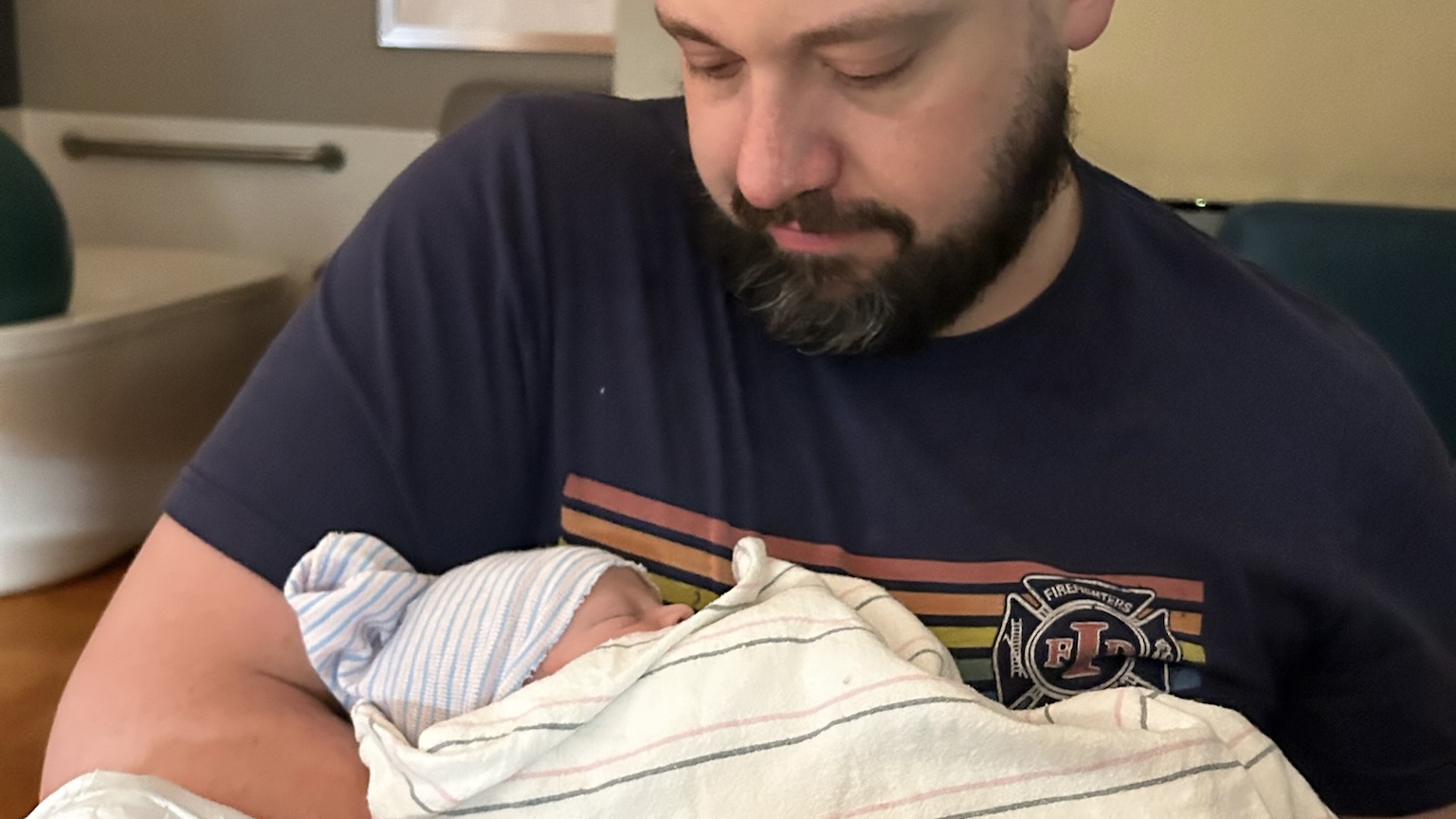
One year ago today was our first real day at home with our newborn daughter.
We had spent the not-unusual two days and nights in the hospital after she was born, taken her home, and then shortly after I had to return to the hospital for my wife to receive additional care. Being in the hospital for our baby’s first few nights at home without us was so hard at the time, but my wife and I have incredible mothers—and families in general—who stepped in to take care of her in our absence. A year ago tonight, when we came home, was the first night of the rest of our lives (all three of them).
There are plenty of things people will tell you about parenthood before you have a baby. Some of it is meaningful, some not-so-much, but almost all of it is well-meaning. The most common one I heard was that becoming a parent really does fundamentally alter your brain chemistry almost immediately, and that you can’t really understand what that means until you experience it. Fair enough, I thought on hearing it. I guessed I would find out when it happened.
Spoiler alert: they were right.
As far as “brain chemistry” goes, I don’t know that I can say that mine is normal to begin with. Being neurodivergent means my brain is fundamentally, biologically, different from a typical1 brain at baseline. I take a couple of medications that make a couple of neurotransmitters more prevalent and effective, but they don’t necessarily normalize my brain chemistry as much as make it seem normal (and let me do stuff like washing the dishes without feeling like I’m putting my hands on a hot stove burner the whole time2).
Outside of my neurological peculiarities, there are some actual well-researched changes that becoming a parent causes to the human brain. Probably most well-known and understood is the increase in oxytocin whenever you have physical contact with your baby. Honestly, this one rocks. Having my baby take a nap on my chest has been better than any antidepressant or anxiolytic I’ve ever taken. There are a lot of other, more practical reasons for the oxytocin surge—particularly for a lactating parent—but I’m not looking that evolutionary gift horse in the mouth.
Of course there are others. In AMAB parents in particular, it causes a drop in testosterone, but also causes your amygdala to become hyperactive. That’s a fun little paradox where you feel less aggression towards others (which was probably mostly to keep our far-back evolutionary ancestors from eating their young out of jealousy) but are constantly on the precipice of fight-or-flight mode. Even better, things that you could normally handle without your sympathetic nervous system kicking in become a full-on crisis.
I spent all of my childhood and most of my adulthood unknowingly masking my autism and ADHD to fit in with my peers and family, constantly feeling like a failure whenever part of the “real me” showed through the cracks in said mask: saying something awkward, forgetting something important, neglecting relationships, etc. Basically I spent the first thirty years of my life in borderline sympathetic activation, with frequently tipped fully into it whenever something went wrong.
It was only through medication and therapy that I was able to [mostly] break that cycle, and feel the pressure of masking slip [again, mostly] out of my life. I simply had not considered that having a baby would make this an issue again, and let me tell you: it has. The tiniest mistakes I make in parenting have caused me to feel like an irremediable failure. I have been sure—or at least my lizard brain has—on a number of occasions that something as simple as my daughter not taking a bottle from me would lead to my wife divorcing me and loosing custody.
Beyond that though, in particular regarding my ADHD, having a baby has been both incredibly difficult but also unbelievable rewarding. When you are responsible for a tiny human who literally can’t do anything but poop, eat, and sleep without it being done to them, it forces your executive function’s hand. You’ll put your hand on that metaphorical hot burner every time, because your baby’s life literally depends on it.
Obviously that is a double-edged sword, because prolonged, forced executive function is exhausting in a way I really don’t know if neurotypical people can understand, but it is also good because baby stays alive. And another fun thing about having a baby is that it rewires your own pre-frontal cortex so that you find the experience of keeping your baby alive more rewarding, ergo more dopamine, which certainly helps with the executive dysfunction.
Really though, at the end of the day, being a parent is something that I think can best be described by another cliche parents-to-be will invariably hear: parenting is the hardest thing you’ll ever love. Beyond the neuroscience or the socio-cultural expectations, that is the philosophical truth I believe everyone who choose to be a parent experiences. Being a parent can be unbelievably difficult. It has brought me to a few of my lowest places emotionally in years.
That said, there isn’t a single fiber of my being that could imagine my life without my daughter. She is an inexorable part of my existence.
And I think that gets to the heart of why it’s so hard to describe parenthood to non-parents, and particularly to those who are about to become parents for the first time. It’s why we reach for cliched maxims and overused similes. It is something the human brain just isn’t wired to be able to build a gestalt3 around until the experience itself rewires your brain to be able to understand it.
I know it’s only been a year, and I have at least 17 more of her living in my house, eating my food, and becoming a whole and complete human being. So I certainly can’t say I’ve definitively understood what it is to be a parent in its entirety, but as far as the initial impressions go, I can only give a future parent this advice: 1) make sure it’s what you really want to do, and 2) nothing else I can tell you will mean anything until you look at your baby for the first time.
- I know, I know. ↩︎
- If you didn’t know, this comes from the metaphor for executive dysfunction used by ADHD folks to describe it to neurotypicals. Basically: you know the thing you need to do needs to get done, and you want to do it, but ADHD brain makes doing it feel the same way the idea of touching your hand to a hot stove burner would feel to anyone ↩︎
- I’d explain what “gestalt” means but I think you can put the pieces together yourself. ↩︎
Leave a Reply